
Introduction

Published: 07 Oct 2026 | Author: Neopharmtech Team

In the pharmaceutical industry, quality cannot be treated as something that is checked only after a product has been manufactured.

Modern pharmaceutical development focuses on building quality into the product and process from the beginning. This approach is known as Quality by Design (QbD).

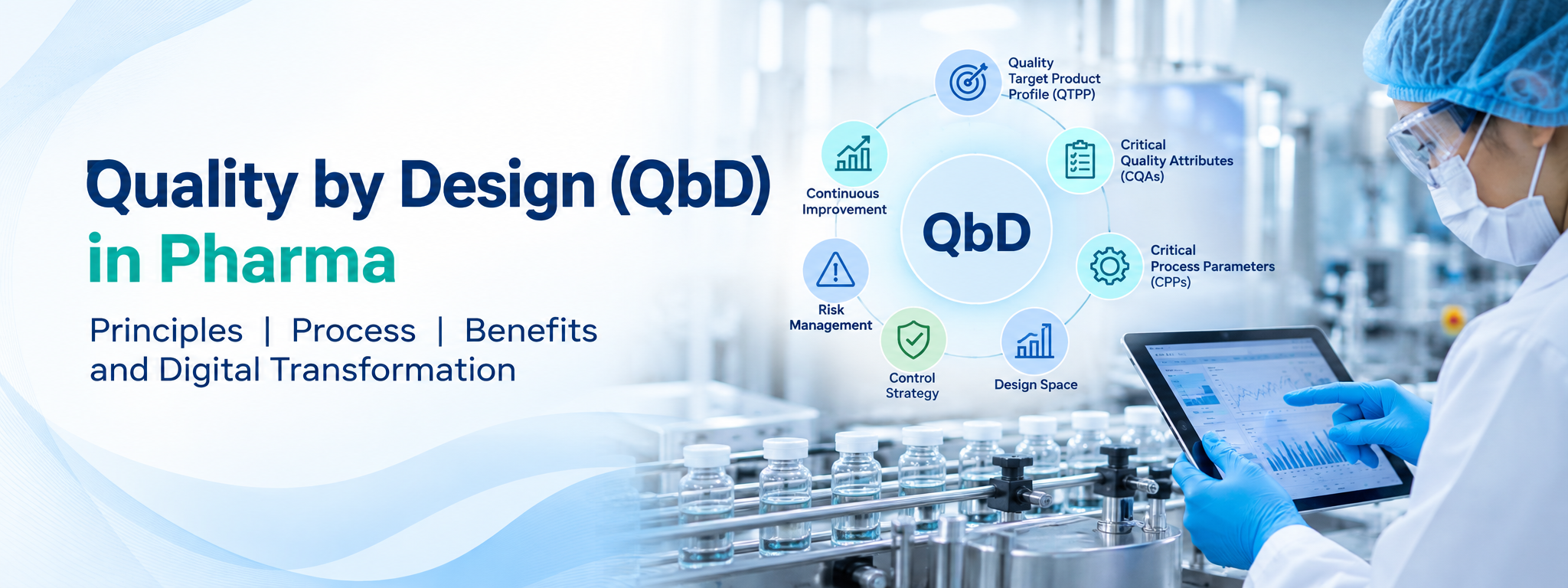
Quality by Design provides a systematic framework for understanding the relationship between product requirements, Critical Quality Attributes (CQAs), Critical Material Attributes (CMAs), Critical Process Parameters (CPPs), risk, process understanding and control strategies.

Instead of relying primarily on end-product testing, QbD encourages pharmaceutical organizations to understand why quality is achieved and how it can be consistently maintained.

What Is Quality by Design (QbD)?

Quality by Design (QbD) is a systematic, science-based and risk-based approach to pharmaceutical development in which predefined quality objectives are established and product and process understanding is developed throughout the development lifecycle.

The fundamental idea is simple:

Quality should be designed into a product and its manufacturing process rather than tested into the product afterward.

QbD asks what quality characteristics are important, what factors can affect those characteristics, what risks are associated with those factors, how those risks can be controlled and how the process can consistently produce the desired quality.

Why Is QbD Important in the Pharmaceutical Industry?

Pharmaceutical products are developed and manufactured in highly regulated environments. Small variations in raw materials, equipment, process parameters, environmental conditions or operating procedures can potentially affect product quality.

QbD encourages organizations to identify and understand potential risks earlier.

  • Build quality into the product
  • Improve process understanding
  • Identify critical variables
  • Manage development risks
  • Establish effective control strategies
  • Reduce process variability
  • Improve manufacturing consistency
  • Support regulatory submissions
  • Facilitate continuous improvement

QbD shifts the focus from “Does the final product pass?” to “Do we understand and control the process that produces the product?”

1. Define the Quality Target Product Profile (QTPP)

The Quality Target Product Profile (QTPP) describes the desired characteristics of the pharmaceutical product. It provides a foundation for product and process development.

Depending on the product, the QTPP may include:

  • Dosage form
  • Route of administration
  • Strength
  • Drug release characteristics
  • Stability
  • Purity
  • Safety
  • Efficacy
  • Packaging requirements

The QTPP establishes what the final product is expected to achieve.

2. Identify Critical Quality Attributes (CQAs)

Critical Quality Attributes (CQAs) are physical, chemical, biological or microbiological characteristics that should remain within appropriate limits or ranges to ensure product quality.

Examples may include:

  • Assay
  • Purity
  • Dissolution
  • Content uniformity
  • Particle size
  • Moisture
  • Sterility
  • Potency
  • Degradation products

CQAs help connect the desired product quality with the materials and processes used to manufacture the product.

3. Identify Critical Material Attributes (CMAs)

Raw materials and starting materials can significantly influence pharmaceutical product quality.

Critical Material Attributes (CMAs) are material characteristics that can have a meaningful impact on CQAs.

Examples include particle size, moisture content, material purity, density and other relevant chemical or physical properties. Understanding these relationships helps organizations determine which material characteristics require tighter control.

4. Identify Critical Process Parameters (CPPs)

Critical Process Parameters (CPPs) are process parameters whose variability can affect a CQA and therefore should be monitored or controlled.

Examples include:

  • Temperature
  • Mixing time
  • Mixing speed
  • Pressure
  • pH
  • Flow rate
  • Drying conditions
  • Compression force

The relationship between CPPs and CQAs is an important component of process understanding.

5. Perform Quality Risk Management

Risk management is one of the most important elements of QbD. Organizations need to identify potential sources of variability and determine their potential impact on product quality.

Common approaches may include:

  • Risk assessment
  • FMEA
  • Fishbone analysis
  • Cause-and-effect analysis
  • Risk ranking
  • Failure mode analysis

A risk-based approach helps organizations prioritize resources toward variables that have the greatest potential impact on quality.

6. Develop a Design Space

A design space represents the established combination and interaction of material attributes and process parameters that have been demonstrated to provide assurance of product quality.

Instead of treating every process parameter as an isolated variable, QbD encourages organizations to understand relationships between multiple variables.

Material properties + process parameters → product quality

Understanding these relationships can provide greater flexibility while maintaining appropriate quality controls.

7. Establish a Control Strategy

Once critical variables and their relationships are understood, an appropriate control strategy can be developed.

A control strategy may include:

  • Raw material controls
  • In-process testing
  • Process parameter controls
  • Equipment controls
  • Environmental monitoring
  • Sampling plans
  • Finished-product testing
  • Automated monitoring
  • Documentation and review

The objective is to maintain the process within an established state of control.

8. Continuous Improvement

QbD does not end when a product reaches the market. Manufacturing and quality data can provide valuable information for continued process improvement.

Organizations can analyze process trends, deviations, OOS results, OOT results, CAPA data, equipment performance, batch performance and environmental data.

This supports a lifecycle approach to pharmaceutical quality.

Quality by Design vs Traditional Quality Approach

Traditional ApproachQuality by Design
Quality heavily dependent on final testingQuality designed into the process
Reactive problem identificationProactive risk identification
Limited process understandingStrong process understanding
Focus on specificationsFocus on product and process knowledge
Fixed process mindsetScience- and risk-based approach
Problems may be identified laterRisks identified earlier
Periodic improvementContinuous improvement

QbD does not eliminate testing or quality control. Instead, it complements testing with scientific understanding, risk management and process control.

Quality by Design and Risk Management

Risk management plays a central role in QbD. A pharmaceutical organization may begin with a broad set of potential variables. Risk assessment can then help determine which variables can significantly affect product quality.

For example:

Raw Material → Material Attributes → Manufacturing Process → Critical Process Parameters → Critical Quality Attributes → Finished Product Quality

Understanding these relationships allows organizations to focus monitoring and controls where they matter most.

Role of Data in Quality by Design

QbD depends heavily on reliable data. Data may come from manufacturing systems, laboratory systems, LIMS, analytical instruments, batch records, stability studies, quality management systems, environmental monitoring, equipment systems and Excel-based calculations.

The challenge is not simply collecting data. Organizations must ensure that data is:

  • Accurate
  • Complete
  • Consistent
  • Traceable
  • Reviewable
  • Secure
  • Available when required

This is where digital transformation becomes increasingly important.

How Digital Systems Support QbD

Modern pharmaceutical organizations generate large volumes of quality and process data. Manual processes can make it difficult to connect information across departments.

Digital systems can help create a more connected quality ecosystem:

Data Collection → Data Validation → Data Review → Risk Analysis → Trend Analysis → Decision Making → Process Improvement

Digital platforms can support structured data capture, automated calculations, workflow-based review, electronic approvals, audit trails, version control, role-based access, data traceability, exception management and trend analysis.

When properly designed and validated, these capabilities can support a more consistent and transparent QbD implementation.

QbD and Data Integrity

Data integrity is critical when quality decisions depend on electronic records. Organizations operating in regulated environments should consider principles such as ALCOA+ when designing systems and workflows.

Electronic systems should provide appropriate controls for:

  • User authentication
  • Role-based permissions
  • Audit trails
  • Electronic signatures
  • Data traceability
  • Record retention
  • Controlled changes

The objective is to ensure that data used for quality decisions remains trustworthy throughout its lifecycle.

QbD in Pharmaceutical and Bioanalytical Laboratories

Although QbD is commonly discussed in pharmaceutical development and manufacturing, its principles can also influence laboratory operations.

Laboratories generate critical information used for product development, stability testing, release testing, bioanalysis, method development and validation.

Digital laboratory systems can help control sample identification, sample traceability, analytical data review, result calculations, document review, audit trails and approval workflows.

This creates an opportunity to extend quality principles beyond manufacturing into laboratory and supporting processes.

Challenges in Implementing QbD

1. Data Silos

Quality, laboratory, manufacturing and development data may exist in separate systems, making relationships between process variables and quality outcomes harder to establish.

2. Manual Data Handling

Manual data transfer can increase the possibility of transcription errors, missing information, incorrect calculations and delayed reviews.

3. Limited Process Understanding

Organizations may not always have sufficient historical or experimental data to understand process variability.

4. Complex Workflows

Risk assessments, investigations, approvals and change management may involve multiple departments and roles.

5. Change Management

Moving from traditional processes to a structured QbD approach requires changes in processes, technology, documentation, training and organizational culture.

How to Build a QbD-Driven Quality Culture

Technology alone cannot implement QbD. Organizations should develop a quality culture where teams continuously ask:

  • What can affect quality?
  • How do we know?
  • What evidence supports our decision?
  • How is the risk controlled?
  • What can we improve?

A strong QbD culture combines scientific thinking, risk-based decision making, quality awareness, reliable data, cross-functional collaboration, process understanding and continuous improvement.

Practical QbD Implementation Framework

Step 1 — Define Quality Objectives

Establish the desired product and process outcomes.

Step 2 — Identify CQAs

Determine which quality attributes are critical.

Step 3 — Identify Material and Process Variables

Identify CMAs, CPPs and other potentially influential factors.

Step 4 — Perform Risk Assessment

Evaluate the likelihood and impact of potential risks.

Step 5 — Conduct Development Studies

Generate scientific evidence to understand relationships and variability.

Step 6 — Establish Design Space

Define acceptable combinations of relevant variables.

Step 7 — Establish Control Strategy

Determine how critical variables will be monitored and controlled.

Step 8 — Monitor Performance

Collect and analyze process and quality data.

Step 9 — Review Trends

Identify emerging risks and opportunities for improvement.

Step 10 — Continuously Improve

Use knowledge and data to improve the process throughout its lifecycle.

The Future of Quality by Design

The future of QbD will increasingly depend on digital technologies. Pharmaceutical organizations are moving toward more connected environments involving digital quality systems, automated data capture, advanced analytics, AI-assisted analysis, electronic workflows, real-time monitoring and predictive quality management.

The combination of QbD and digital transformation can help organizations move from reactive quality management to proactive quality intelligence.

However, automation should not replace scientific and quality judgment. Technology should provide better data, better visibility, stronger controls and faster identification of potential risks.

Key Benefits of Quality by Design

Better Product Understanding

Organizations gain a deeper understanding of how materials and processes influence product quality.

Reduced Risk

Potential quality risks can be identified and addressed earlier.

Improved Process Consistency

Understanding process variability supports more consistent manufacturing.

Better Decision Making

Scientific and data-driven decisions can replace assumptions.

Improved Regulatory Readiness

Structured development knowledge and documented control strategies can support regulatory interactions.

Continuous Improvement

Process and quality data can be used to identify improvement opportunities throughout the product lifecycle.

Stronger Data Integrity

Controlled digital workflows can improve traceability and accountability.

Conclusion

Quality by Design is more than a pharmaceutical development methodology. It is a way of thinking about quality.

Instead of relying primarily on final testing to determine whether quality has been achieved, QbD encourages organizations to understand the product, understand the process, identify risks, establish appropriate controls and continuously improve based on evidence.

As pharmaceutical and life-science organizations become increasingly digital, the combination of QbD, risk management, data integrity, automation and digital quality systems can create a stronger foundation for sustainable quality.

The goal is not simply to detect quality problems. The goal is to understand, control and continuously improve the processes that create quality.

Frequently Asked Questions

What is Quality by Design (QbD) in pharma?

Quality by Design (QbD) is a systematic, science- and risk-based approach to pharmaceutical development that focuses on understanding and controlling product and process variables to consistently achieve predefined quality objectives.

What are the main elements of QbD?

Important QbD elements include QTPP, CQAs, CMAs, CPPs, risk assessment, process understanding, design space, control strategy and continuous improvement.

What is the difference between QbD and quality control?

Quality control focuses on monitoring and testing products and processes to verify that requirements are met. QbD goes further by designing quality into the product and process through scientific understanding and risk-based controls.

How does technology support QbD?

Digital systems can support QbD through controlled data capture, automated calculations, audit trails, electronic workflows, data traceability, trend analysis and risk-based decision making.

Is QbD applicable only to pharmaceutical manufacturing?

No. QbD principles can also support pharmaceutical development, analytical laboratories, bioanalytical operations, quality systems and other regulated processes where product and process quality must be understood and controlled.

How does QbD support continuous improvement?

QbD creates a framework for collecting and analyzing process and quality information. Organizations can use this knowledge to identify variability, evaluate risks, optimize processes and improve control strategies throughout the product lifecycle.

Ready to Build Quality into Your Digital Workflows?

Discover how digital workflows, data integrity, automation and controlled review processes can support a more proactive approach to quality.
Explore Neopharmtech solutions for regulated pharmaceutical and life-science workflows.
Contact Neopharmtech to discuss how digital technology can support your quality and process transformation initiatives.

Request a Demo

Our Solutions

Neopharmtech's specialized software ecosystem supports pharmaceutical, CRO and laboratory operations through electronic logbooks, laboratory data management, document review, inventory tracking and Excel automation, helping organizations improve productivity, traceability and data integrity.

↑