
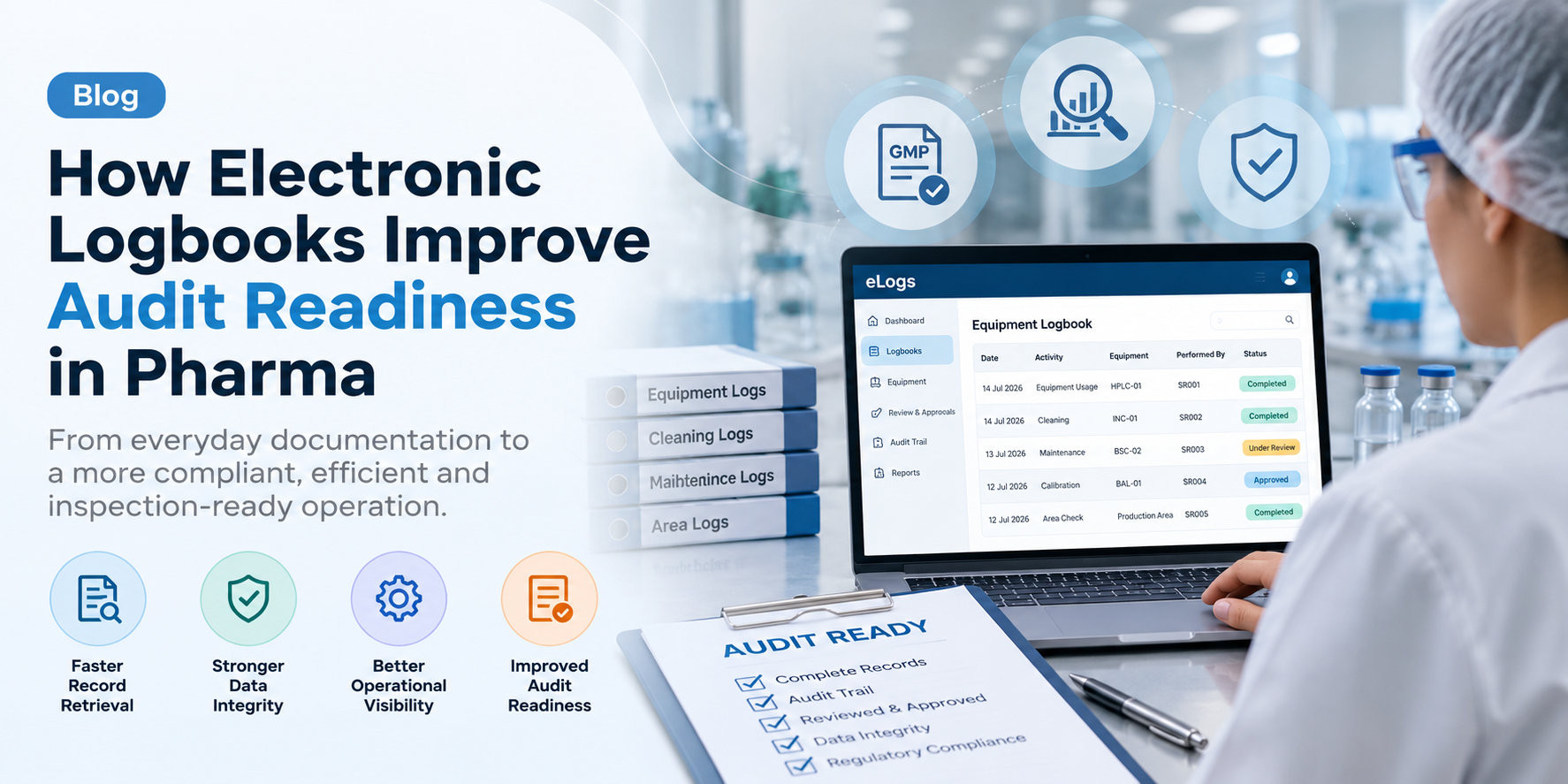
Why Audit Readiness Starts with Everyday Documentation

Published: 06 Oct 2026 | Author: Neopharmtech Team

Pharmaceutical organizations generate operational records every day. Equipment usage, cleaning activities, maintenance, calibration, environmental monitoring, laboratory activities, area checks, utility operations and other routine tasks all require accurate documentation.

For many organizations, these activities still depend on paper logbooks. Paper may appear simple, but when an auditor asks for a complete history of an equipment, a specific activity, or a particular date, retrieving and verifying that information can become a time-consuming exercise.

This is where electronic logbooks in pharma can make a significant difference.

An electronic logbook does more than replace paper with a computer screen. When appropriately designed and validated, it can create a structured environment for recording, reviewing, approving and retrieving operational information while strengthening data integrity and inspection readiness.

From Documentation Storage to Operational Intelligence

One of the biggest differences between paper and electronic logbooks is how information can be used.

A paper logbook primarily acts as a record. An electronic logbook can become an operational information source.

Instead of simply recording that an activity occurred, a digital system can associate the activity with relevant information such as:

  • Equipment or asset
  • User
  • Date and time
  • Activity type
  • Batch or project
  • Status
  • Review and approval
  • Comments and supporting records

This structured information makes it easier to search, review and analyze historical activities. The goal is therefore not simply to create a paperless logbook, but to create controlled, traceable and usable operational data.

1. Faster Retrieval of Historical Records

During an audit, finding the correct record quickly can be extremely valuable.

With paper records, personnel may need to identify the relevant logbook, locate the correct date range, search through multiple pages, verify signatures and timestamps, and cross-check related records.

Electronic logbooks can simplify this process. Authorized users can search records using predefined criteria such as:

  • Equipment
  • Date range
  • User
  • Activity
  • Batch
  • Department
  • Status
  • Record number

Instead of searching through physical pages, users can retrieve the required information from a centralized system. This can help organizations respond to audit requests more efficiently.

2. Better Visibility of Equipment History

Equipment history is an important part of pharmaceutical operations.

Consider a laboratory instrument or manufacturing equipment. Its operational history may include Usage → Cleaning → Maintenance → Calibration → Breakdown → Repair → Return to Service.

When these activities are documented separately, reconstructing the complete history can require manual reconciliation. An electronic logbook can provide a more structured history for the asset.

This can help reviewers determine how frequently equipment was used, when maintenance occurred, whether calibration activities were completed, whether breakdowns occurred and who performed specific activities.

3. Strengthening Data Integrity

Data integrity is not simply about storing information electronically. The information must remain trustworthy throughout its lifecycle.

For electronic logbooks, organizations should consider controls around:

  • User identification
  • Access permissions
  • Data entry
  • Record modification
  • Electronic signatures
  • Audit trails
  • Review workflows
  • Record retention
  • System security

A properly controlled electronic environment can provide stronger mechanisms for demonstrating who performed an activity and when it occurred.

4. Making Review More Consistent

Paper-based review can depend heavily on manual checking. A reviewer may need to examine dates, times, signatures, required fields, remarks, attachments, corrections and supporting documentation.

Electronic workflows can introduce standardized review steps. For example:

Operator Entry → Supervisor Review → QA Review → Approval

The exact workflow can be configured according to the organization's procedures and risk requirements. This can help reduce variation in how records are reviewed and create a defined process for moving records from one stage to another.

5. Identifying Missing Documentation Earlier

One advantage of structured digital records is that the system can be designed to identify incomplete information.

Depending on the configuration, an electronic workflow may help identify:

  • Missing mandatory fields
  • Missing approvals
  • Incomplete activities
  • Pending reviews
  • Overdue actions
  • Records awaiting correction

This is useful because documentation problems are easier to address when identified close to the time the activity occurs rather than weeks later during audit preparation.

6. Creating a Clearer Audit Trail

An audit trail is an important control to consider when implementing electronic records. For regulated environments, it is important to understand not only the current value of information but also the history of relevant changes.

An electronic logbook can be designed to capture events such as:

  • Record creation
  • Record modification
  • User identity
  • Date and time
  • Reason for change
  • Review activity
  • Approval activity

This provides a chronological history of relevant system activity. The objective is not simply to generate an audit-trail report; the audit trail should support the organization's overall data-integrity and review processes.

7. Connecting Documentation with Quality Processes

Operational records do not exist independently from the quality system. A logbook entry may reveal equipment failure, repeated breakdowns, cleaning issues, maintenance delays, environmental excursions or repeated operational problems.

These events may require further quality-system actions depending on the organization's procedures.

A digital logbook can therefore become a useful source of information for quality teams:

Logbook Event → Review → Assessment → Deviation/CAPA if Required → Closure

This creates an opportunity to connect routine operational documentation with broader quality processes.

8. Reducing Dependence on Individual Knowledge

Paper-based processes can sometimes depend on experienced employees knowing where a particular logbook is stored, which register contains specific information, how a record should be reviewed and which documents need to be checked together.

A standardized electronic workflow can make the process more consistent through defined forms, workflows, roles, approval steps, record structures and search mechanisms.

This can make processes easier to follow, particularly when organizations grow or employees move between roles.

9. Supporting Multi-Department Operations

Large pharmaceutical organizations may have multiple departments maintaining different operational records.

Production

  • Equipment operation
  • Cleaning
  • Area checks
  • Shift activities

Quality Control

  • Instrument usage
  • Laboratory activities
  • Environmental records

Engineering

  • Maintenance
  • Breakdown
  • Utility activities

Quality Assurance

  • Review
  • Approval
  • Compliance monitoring

When each department uses separate paper records, obtaining a consolidated view can be difficult. An electronic logbook platform can provide a common digital framework while still allowing department-specific workflows and permissions.

10. Moving from Reactive to Proactive Documentation Management

Traditional logbook management is often reactive: something happens, it gets recorded, and someone reviews it later.

Digital workflows create opportunities for a more proactive approach. For example:

Upcoming calibration → notification → activity → review → approval

or:

Maintenance due → assignment → completion → verification → closure

This approach can help organizations manage operational activities before they become overdue. The objective is not to automate every decision, but to make important activities visible and assignable to the appropriate personnel.

Electronic Logbooks and Inspection Readiness

Inspection readiness is ultimately about being able to demonstrate control.

An organization should be able to show that activities are performed according to procedures, records are created appropriately, responsibilities are clearly assigned, changes are controlled, reviews are performed, records are traceable and data remains available when required.

Electronic systems can support these objectives through structured records, controlled access, workflows, audit trails and electronic approvals.

Software alone does not guarantee compliance. The system must be appropriately configured, validated where required, governed by procedures and used correctly by trained personnel.

What Should Organizations Consider Before Implementing eLogbooks?

Step 1: Identify Existing Logbooks

Create an inventory of current paper and electronic records and categorize them by department, equipment, activity, criticality, frequency and responsible role.

Step 2: Identify Documentation Risks

  • Repeated manual entries
  • Missing signatures
  • Delayed reviews
  • Difficult record retrieval
  • Duplicate records
  • Manual reconciliation
  • Unclear ownership
  • Frequent corrections

Step 3: Define the Desired Workflow

Determine who creates, reviews and approves the record, what information is mandatory, what happens when information is incorrect and which records require escalation.

Step 4: Define Data-Integrity Controls

Consider user authentication, role-based permissions, electronic signatures, audit trails, record retention, backup, security and change control.

Step 5: Start with High-Value Use Cases

Organizations do not necessarily need to digitize every logbook on day one. A phased implementation can begin with high-volume or high-risk processes and expand over time.

Paperless Does Not Mean Control-Less

One common misconception is that digitization automatically improves compliance. It does not.

A poorly designed electronic system can simply convert a paper problem into a digital problem. An electronic logbook should not allow unrestricted editing simply because the record is digital. Likewise, electronic signatures, audit trails and access controls should be implemented as part of an overall validated and governed process.

The objective should be:

Digital + Controlled + Traceable + Reviewable

rather than simply:

Digital instead of Paper

This distinction is critical when implementing electronic systems in regulated environments.

The Future of Electronic Logbooks

Electronic logbooks are becoming part of a broader digital ecosystem. Future implementations can increasingly connect operational records with systems such as:

  • Equipment management systems
  • Maintenance management
  • Laboratory systems
  • Quality management systems
  • Manufacturing systems
  • Environmental monitoring
  • Asset management
  • Analytics platforms

This creates an opportunity to move from isolated records toward connected operational data.

For example:

Equipment → Usage → Maintenance → Calibration → Quality Event → Review

When these relationships are available digitally, organizations can gain better visibility into operational performance and recurring issues.

How Neopharmtech eLogs Can Help

Neopharmtech eLogs is designed to help pharmaceutical, CRO, laboratory and other regulated organizations transition from paper-based operational records to controlled electronic workflows.

Rather than treating an electronic logbook as simply a digital replacement for a paper register, the platform focuses on creating structured records with controlled access, workflow-based review, traceability and electronic approvals.

Organizations can use eLogs to build digital workflows around their operational documentation while maintaining appropriate controls for regulated environments.

The platform can support different types of operational records and can be configured according to organizational processes.

Learn more about Neopharmtech eLogs and how electronic logbook workflows can support your organization's digital transformation.

Conclusion

Electronic logbooks are not simply about eliminating paper. Their real value comes from creating a more structured way to manage operational information.

For pharmaceutical organizations, the transition from paper to electronic records can provide opportunities to improve:

  • Audit readiness
  • Record retrieval
  • Equipment history
  • Data integrity
  • Review consistency
  • Operational visibility
  • Documentation control
  • Quality oversight

The most effective approach is to treat eLogbook implementation as a process transformation project, not just a software deployment.

When technology, procedures, validation, data governance and user training work together, electronic logbooks can become an important part of a modern pharmaceutical documentation environment.

Ready to move beyond paper logbooks?

Explore Neopharmtech eLogs and discover how controlled electronic documentation can help your organization build a more traceable, efficient and inspection-ready operation.

Frequently Asked Questions

What is an electronic logbook in pharma?

An electronic logbook is a controlled digital system used to record, review, approve and retrieve operational activities such as equipment usage, cleaning, maintenance, calibration and other regulated activities.

How do electronic logbooks improve audit readiness?

Electronic logbooks can improve audit readiness by making records easier to retrieve and review while providing structured workflows, access controls, traceability, audit trails and electronic approvals.

Can electronic logbooks support data integrity?

Yes. When appropriately configured and governed, electronic logbooks can support data-integrity controls such as user identification, role-based access, audit trails, electronic signatures, controlled workflows and record retention.

Can eLogs be used for equipment and maintenance records?

Yes. Electronic logbooks can be configured for equipment usage, cleaning, maintenance, calibration, breakdowns, repairs, area checks and other operational records.

Does electronic logbook software automatically guarantee compliance?

No. Software alone does not guarantee compliance. The system should be appropriately configured, validated where required, governed by procedures, secured and used by trained personnel.

Ready to Move Beyond Paper Logbooks?

Discover how Neopharmtech eLogs can help your organization digitize operational records, improve traceability, streamline review workflows and strengthen documentation control.
Schedule a personalized demo to explore electronic logbook workflows for your pharmaceutical, laboratory or regulated operations.
Contact Neopharmtech today to learn how eLogs can support a more efficient and inspection-ready documentation environment.

Request a Demo

Our Solutions

Neopharmtech's specialized software ecosystem supports pharmaceutical, CRO and laboratory operations through electronic logbooks, laboratory data management, document review, inventory tracking and Excel automation, helping organizations improve productivity, traceability and data integrity.

↑