
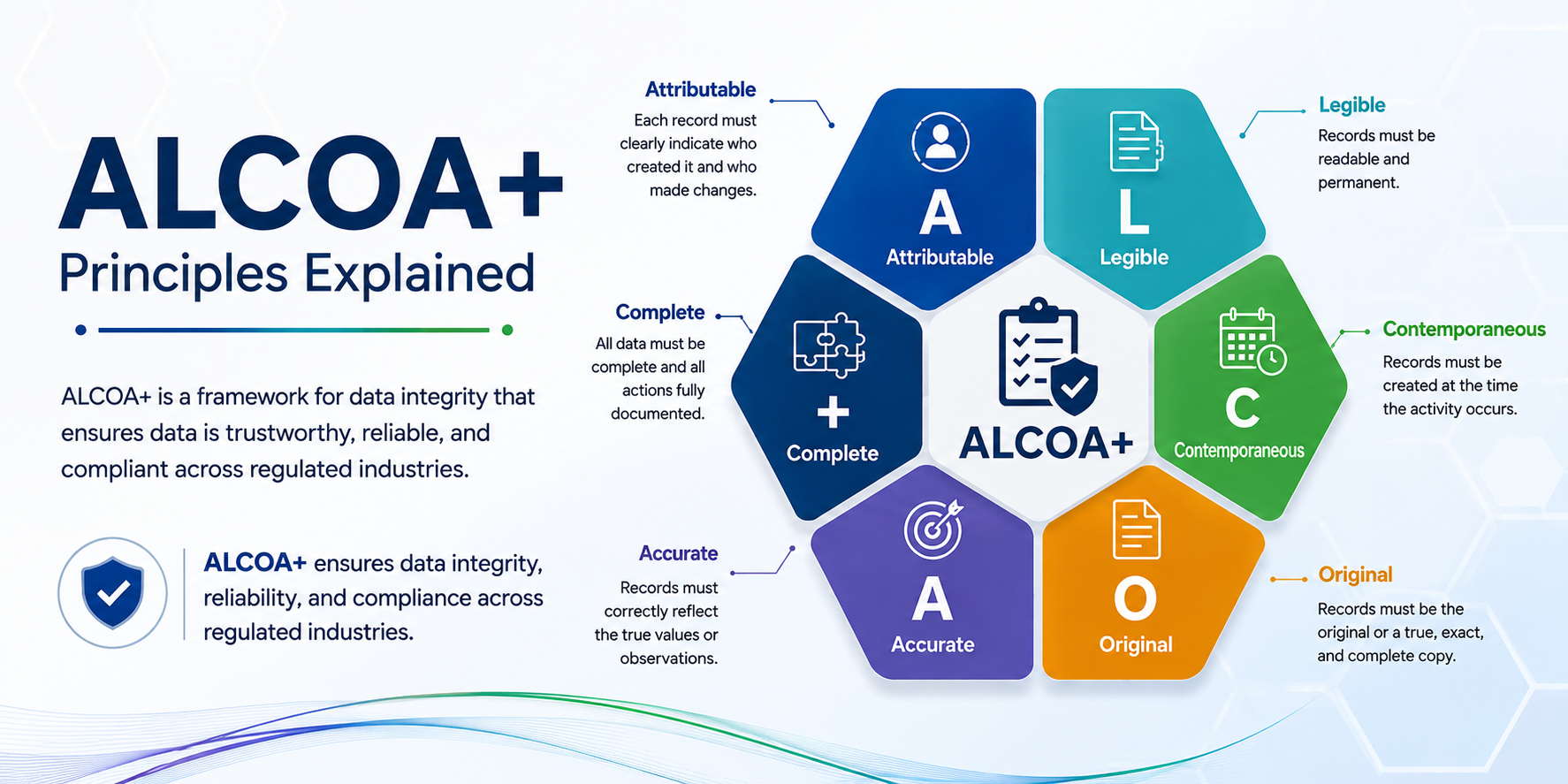
In pharmaceutical research, clinical trials, manufacturing, and laboratory operations, maintaining data integrity is critical for regulatory compliance and patient safety. ALCOA+ Principles provide a globally accepted framework to ensure that records are trustworthy, complete, and reliable throughout their lifecycle.
What is ALCOA+?
ALCOA+ is a set of principles developed to ensure data integrity in regulated industries. Regulatory authorities including FDA, EMA, MHRA, and WHO expect organizations to follow these principles when generating, processing, reviewing, and storing data.
The acronym ALCOA stands for:
- A – Attributable
- L – Legible
- C – Contemporaneous
- O – Original
- A – Accurate
The "+" expands the framework with:
- Complete
- Consistent
- Enduring
- Available
1. Attributable
Data must clearly identify the individual who performed an action and the date and time it occurred. Every entry should be traceable to a specific person through user IDs, electronic signatures, or audit trails. This accountability helps organizations investigate issues, verify activities, and maintain trust in recorded information. Proper attribution also supports regulatory inspections and compliance requirements.
2. Legible
Information should be readable, understandable, and permanently preserved throughout its retention period. Whether records are maintained electronically or on paper, they must remain clear and accessible without ambiguity. Legible records reduce the risk of misinterpretation and support accurate decision-making. Maintaining readability is essential for audits, inspections, and long-term record management.
3. Contemporaneous
Data should be recorded at the time an activity is performed rather than being documented later from memory. Real-time recording ensures that information accurately reflects the actual event or observation. This practice minimizes errors, omissions, and opportunities for data manipulation. Contemporaneous records provide a reliable history of activities and support data integrity.
4. Original
The first capture of data or a verified true copy should be preserved as the official record. Original records provide evidence that information has not been altered or improperly modified. Organizations should maintain source documents and ensure their authenticity throughout the record lifecycle. Preserving original data strengthens confidence in study results and operational decisions.
5. Accurate
Data must correctly represent the activity, observation, or result being recorded. Information should be free from errors, omissions, and unauthorized changes that could affect reliability. Any corrections made to records should be properly documented and remain fully traceable. Accurate data is essential for maintaining product quality, patient safety, and regulatory compliance.
6. Complete
All information generated during a process must be retained, including repeat analyses, failed results, and deviations. Records should provide a full and transparent picture of activities without selectively excluding data. Maintaining complete records supports objective decision-making and regulatory review. Completeness ensures that the entire history of an event or process can be reconstructed when needed.
7. Consistent
Data should follow a logical and chronological sequence throughout its lifecycle. Dates, times, and recorded activities must align correctly without unexplained gaps or discrepancies. Consistency helps demonstrate that processes were performed according to approved procedures. Well-organized and consistent records improve traceability and support reliable audits.
8. Enduring
Records must be maintained in a durable format that protects them from loss, damage, or unauthorized modification. Electronic systems should include appropriate backup, security, and retention mechanisms. The information must remain intact and retrievable for the entire required retention period. Enduring records help ensure long-term compliance and business continuity.
9. Available
Data should be readily accessible whenever required for review, audits, inspections, or regulatory submissions. Authorized personnel must be able to retrieve records quickly without compromising security or integrity. Availability ensures transparency and supports timely decision-making across the organization. Maintaining accessible records is a key requirement for demonstrating regulatory compliance.
Why ALCOA+ Matters
- Strengthens data integrity and reliability.
- Supports regulatory compliance.
- Improves inspection readiness.
- Reduces risk of data manipulation.
- Enhances patient safety and product quality.
- Builds trust in clinical and laboratory records.
ALCOA+ in Digital Systems
Modern electronic systems such as eCRF platforms, Laboratory Information Management Systems (LIMS), Quality Management Systems (QMS), and Document Management Systems (DMS) are designed to support ALCOA+ compliance through audit trails, electronic signatures, role-based access controls, and secure record retention.
Conclusion
ALCOA+ Principles serve as the foundation of data integrity across pharmaceutical, biotechnology, healthcare, and clinical research organizations. By implementing these principles, organizations can ensure compliance, maintain audit readiness, and build confidence in the accuracy and reliability of their records.